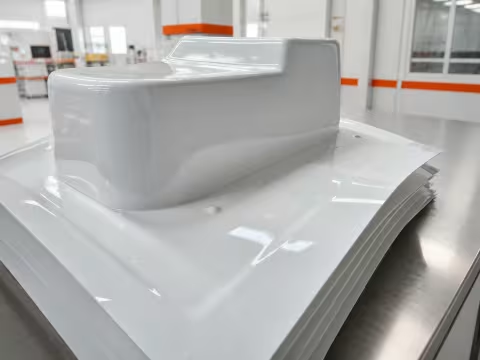
Five vacuum-formed parts that make up one set. Three of them are formed simultaneously from a single sheet — an optimization that lowers the unit cost at 50 sets per month.
The Challenge
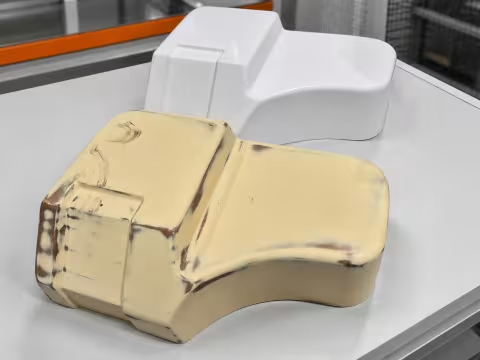
The client needed not a single part, but a set of five — each with its own free-form shape, different size, and different function. The parts cover the structural sections of the product and sit above the internals and electronics: both visible surfaces and functional elements at once.
The largest of the five is 650 mm wide, with pronounced transitions, internal pockets, and precise mounting zones.
Two things had to be solved at once: confirming the geometry before committing to permanent moulds, and finding a way to produce five different parts every month without the unit cost multiplying by five.
Engineering Approach
The MDF mould — not a trial, but a starting point
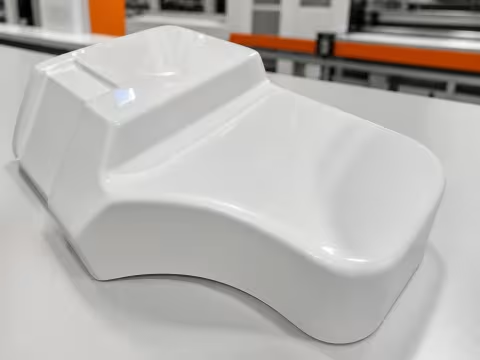
We started with an MDF mould. It's fast and inexpensive compared to a permanent one, and it allows real forming, not just a visual check.
The MDF mould produced three different things: real parts for testing (10–20 pieces), a casting for the permanent two-component mould, and a fixture for precise positioning on the 5-axis machine during trimming.
One geometry, made once, became the basis for the entire tooling set.
The permanent mould — for the series
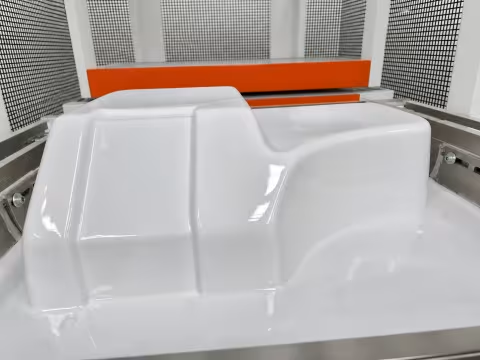
The two-component mould is smooth, durable, and predictable. It handles series of 20 to 100 pieces and delivers repeatable surface quality.
When volumes justify it, the same geometry can be made in aluminum — at that point the mould practically has no shelf life limit.
Why the wall thickness stays even
With deep parts, the most common defect is thinning at the highest point. The material stretches unevenly — where it travels furthest, the wall becomes thinnest.
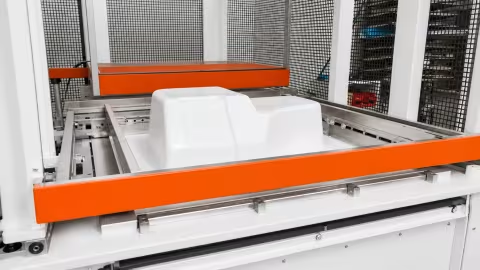
Our machine works in a different order. It's airtight, and before forming even begins, it pre-blows the sheet to about a third of the mould's height. The material is stretched in advance, evenly, across its whole surface, before it ever touches the form — the result is a part with even thickness everywhere, including at the top.
The rest comes from the construction: heating from both above and below; a powerful clamping frame; and a heavy-duty build that handles great forming depth and thick sheets — up to 950 × 850 × 700 mm and material up to 12 mm.
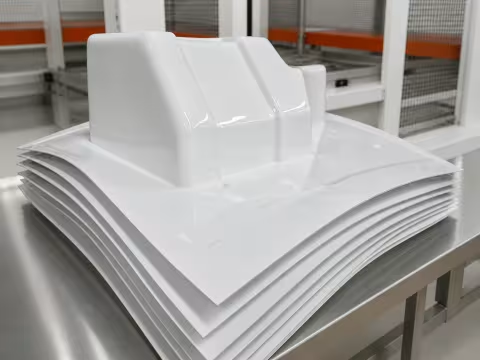
Grouping — three parts from one sheet
The blank is a standard sheet section, 1000 × 1000 mm. The two large parts each take up one sheet. But the remaining three are small enough to be arranged together.
We made their three moulds to work simultaneously — in a single cycle, on one blank, with the nesting layout calculated in advance so there's no wasted material between them.
The result: one set of five parts is produced in three cycles instead of five — at 50 sets a month, that's the difference between 250 and 150 machine cycles.
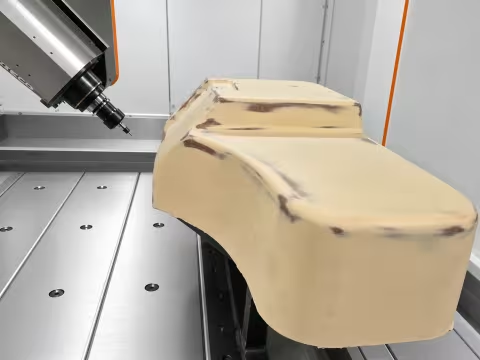
Trimming — 5-axis CNC on a dedicated fixture
After forming, every part has excess material around its edges. Trimming a free-form shape requires the part to be held exactly as it was in the mould — otherwise the contour shifts.
The MDF fixture mirrors the shape of the panel. The part sits into it, the machine knows exactly where every point is, and the contour comes out identical on every piece.
Engineering Note
When an MDF mould is the smarter place to start
A permanent mould pays for itself on volume. The problem is that it's made before you know whether the geometry works.
MDF reverses the order. It's made quickly, costs little, and produces real parts — 10 to 20 pieces, enough for testing under real conditions. If something needs to change, the change is cheap.
If the shape is confirmed, the MDF mould isn't discarded — it produces the casting for the permanent form and the fixture for CNC machining.
In other words, the cost of the trial isn't wasted spend. It's the first step of the tooling itself.
Process Route
Technical Data
| Parts in the set | 5 |
| Moulds made | 5 |
| Blank | 1000 × 1000 mm, standard sheet section |
| Cycles per set | 3 (instead of 5) |
| Monthly output | 50 sets |
| Width of the largest part | 650 mm |
| Maximum part dimensions | 950 × 850 × 700 mm |
| Material thickness | up to 12 mm |
| MDF mould | 10–20 pieces |
| Two-component mould | 20–100 pieces |
| Aluminum mould | no practical limit |
R&D and DFM → CAD → MDF mould making → trial forming → part testing → casting → two-component mould → series vacuum forming → CNC fixture → 5-axis trimming → inspection → packaging
Every stage happened in-house at NEON.BG — including mould making, which is usually outsourced.
Result
The project is in regular production — 50 sets a month, meaning 250 parts.
The client got tested parts first, then series production, without paying for permanent moulds before being sure of the geometry. The tooling, made once, covers the product's entire lifecycle: a short test batch, permanent forms for production, and fixtures for precise trimming.
And grouping the three smaller parts into one cycle lowered the unit cost permanently — not as a one-off, but on every batch since.
From the trial to the permanent production tool
Our recommendation for products like this: start with a trial, then batches of at least 30 pieces. That way the setup cost is spread sensibly, and quality stays repeatable.

